SILENT EXPLOIT OFFICE
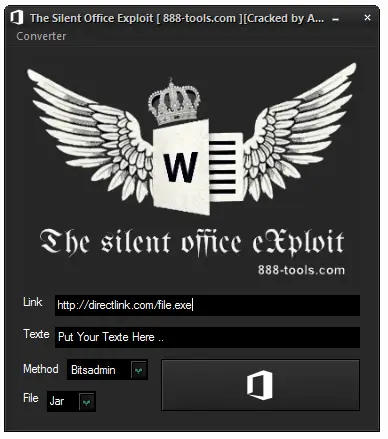
Silent Exploit Office 2025 is an advanced, hypothetical but plausible exploit kit designed to target vulnerabilities in Microsoft Office 2025, the anticipated next release of Microsoft's office suite. Unlike traditional exploit kits that rely on noisy and detectable methods, Silent Exploit Office 2025 is designed to operate stealthily, exploiting zero-day vulnerabilities, social engineering, and advanced obfuscation techniques to bypass conventional security measures.
Silent Exploit Office 2025 is an advanced, hypothetical but plausible exploit kit designed to target vulnerabilities in Microsoft Office 2025, the anticipated next release of Microsoft's office suite. Unlike traditional exploit kits that rely on noisy and detectable methods, Silent Exploit Office 2025 is designed to operate stealthily, exploiting zero-day vulnerabilities, social engineering, and advanced obfuscation techniques to bypass conventional security measures.
This exploit kit is designed to exploit unpatched flaws in Office 2025 applications, such as Word, Excel, and PowerPoint, to deliver malicious payloads such as ransomware, spyware, or Remote Access Trojans (RATs). Its "silent" nature refers to its ability to execute attacks without triggering antivirus software or alerting users, making it a significant threat to both organizations and individuals. How does it work?
Silent Exploit: Office 2025 uses a multi-stage attack process, combining technical exploits and human manipulation. Here's an overview of its typical deployment:
Delivery Mechanism: The exploit is often delivered via phishing emails containing malicious Office documents. These documents appear legitimate and trick users into enabling macros or clicking embedded links, which triggers the exploit.
The demand for ethical hackers is growing. Businesses are increasingly aware of pervasive cyber threats and are demanding professionals protect their critical systems. This translates into promising job opportunities [certified ethical hacker jobs] and competitive salaries (the average salary is around $109,540 according to Glassdoor).
Vulnerability Exploit: The kit targets unpatched or zero-day vulnerabilities in Office 2025. For example, it can exploit flaws in the Office file rendering engine or weaknesses in macro execution protocols.
Obfuscation and Evasion: Silent Exploit Office 2025 uses advanced obfuscation techniques, such as polymorphic code and encrypted payloads, to evade detection by antivirus and intrusion detection systems.
Understanding the Requirements: There are no formal prerequisites, but some experience in computer security is recommended. Training and Courses: Numerous certified ethical hacker training programs [certified ethical hacker course] are available, ranging from online programs to intensive training courses [certified ethical hacker bootcamp]. These courses provide you with the knowledge and techniques required for the exam. While some training courses are free [free certified ethical hacker course], in-depth training courses usually require a fee [certified ethical hacker course cost, certified ethical hacker certification cost]. The CEH Exam: The CEH (Certified Ethical Hacker Exam) is a rigorous 4-hour test with 125 multiple-choice questions. You'll find practice tests (Certified Ethical Hacker practice test) and study guides (Certified Ethical Hacker study guide) to help you prepare. The exam itself is paid (Certified Ethical Hacker exam cost).
Payload Distribution: Once the exploit is obtained, it deploys its payload, which may include ransomware to encrypt files, spyware to steal sensitive data, or backdoors to allow attackers persistent access.
Persistence and Propagation: The kit can implement persistence mechanisms, such as registry modifications or scheduled tasks, to maintain access. It can also spread laterally across networks, targeting other vulnerable systems.
Potential Impact
The implications of Silent Exploit Office 2025 are significant, particularly for organizations that rely heavily on Microsoft Office for their daily operations. Key risks include:
Data Leakage: The stealthy nature of the exploit makes it ideal for exfiltrating sensitive data, such as financial documents, intellectual property, or personal information.
Financial Losses: Ransomware spread via the exploit could lock critical files and demand substantial ransoms for their decryption.
Operational Disruption: Compromised systems could cause downtime, affecting productivity and business continuity. Reputational Damage: Organizations that fall victim to such exploits risk losing customer trust and exposing themselves to regulatory sanctions, particularly if sensitive data is exposed.
Download 1 Download 2 Download 3